Showing posts with label disease. Show all posts

Friday, May 29, 2015

$86M worth of Armstrong stock sold by Asbestos Personal Injury Settlement Trust

The Asbestos Personal Injury Settlement Trust was created when Armstrong World Industries emerged from a bankruptcy reorganization in 2006. It takes care of asbestos related lawsuits and claims against Lancaster-based Armstrong, which had asbestos in insulation it stopped selling in 1969. Asbestos is now banned due to its association with asbestosis and mesothelioma.

Armstrong World Industries, Inc. is a Pennsylvania corporation incorporated in 1891. Created in Pittsburgh in 1860, the company originally made wine bottle corks. By the 1890s, Armstrong World Industries was the world’s largest cork company and leveraged its size and success to expand its product line. Armstrong soon made insulating corkboard, fiberboard and other similar products. It also began a linoleum flooring business, which led to the production of vinyl and other flooring materials. Although this 20th century growth was profitable for Armstrong, use of asbestos in its products eventually led to its bankruptcy filing in 2000. They filed for bankruptcy in December 6, 2000, and reorganized on August 18, 2006. Armstrong is a designer and manufacturer of floors and ceilings. Based in Lancaster, Pennsylvania, Armstrong operates 32 plants in eight countries and has approximately 8,500 employees worldwide.

The trust has a value of over $2 million when it was established in 2006. The corporation had approximately $2.9 billion in revenue in 2011 and is the world’s largest manufacturer of hardwood flooring.

Armstrong’s asbestos-related court battles began in the 1970 landmark case of Borel v. Fibreboard Paper Products Corporation. Clarence Borel sued Armstrong and 10 other manufacturers of asbestos insulation after developing an asbestos-related disease following his many years of working with their products. This was the first case that recognized it was a manufacturer’s duty to warn of asbestos dangers and the case became the foundation for all future asbestos claims.

Over the next few decades, thousands of new asbestos claims were brought against Armstrong and the company paid millions of dollars as courts ruled they knowingly disregarded the health of its employees and consumers by using asbestos in its products.

Miller v. Armstrong World Industries, Inc., decided based on Colorado law in 1991, turned into a precedent-setting case for asbestos litigation. Raymond Miller was an insulator from 1946 to 1951 and knowingly handled asbestos products from Armstrong, but he did not know asbestos was dangerous. In his claim, he said he learned of the dangers in the 1970s while reading about asbestos. Miller developed asbestosis. Armstrong's summary judgment victory was overturned on appeal.

The case set precedent under Colorado law because it held that discovery of an initial asbestos-related disease did not trigger the running of Colorado's statute of limitations on a separate disease that manifested later. In this case, for example, the discovery of asbestosis-related pleural thickening did not trigger the two-year statute of limitations that would have prevented Miller from filing an asbestosis claim.

By 2000, the cost of asbestos litigation forced the company into bankruptcy. As part of their emergence from bankruptcy and reorganization in 2006, Armstrong established the Armstrong World Industries Asbestos Trust, which was intended to settle all current and future asbestos-related claims. In its first two years, the trust received more than 200,000 claims.

Thursday, December 20, 2007

Angelman syndrome - Colin Farrell's four-year-old son has it

This is one of two syndromes (Angelman and Prader-Willi) which have different presentations depending on which parent - the father or the mother had the defective genes. That means, we can know whether Mr Colin Farell had the defective genes or the mother of the boy.


Angelman syndrome comes from defective maternal chromosome 15, so, it was from the mother. And, we can also conclude that Colin Farell's son's children will not have Angelman syndrome but rather has a high chance (25%) of getting Prader Willi syndrome.

Angelman syndrome (AS) is a rare neuro-genetic disorder named after a British pediatrician, Dr. Harry Angelman, who first described the syndrome in 1965. AS is characterised by intellectual and developmental delay, speech impediment, sleep disturbance, unstable jerky gait, seizures, hand flapping movements, frequent laughter/smiling and usually a happy demeanour. AS is a classic example of genetic imprinting caused by deletion or inactivation of critical genes on the maternally inherited chromosome 15.


The sister syndrome is called Prader-Willi syndrome, and is caused by loss of paternal genes.

An older, alternative term for AS, happy puppet syndrome, is generally considered pejorative and stigmatizing so it is no longer used, though it remains useful as a diagnostic heuristic.


Colin Farrell said Tuesday that his 4-year-old son James, who has a rare neuro-genetic disorder called Angelman Syndrome, is making progress – and that father and son will be together at the holidays.

The actor, 31, told PEOPLE at a New York screening of his film Cassandra's Dream that James's progress is "good" and stressed that the Angelman is a condition, "not a disease."

With the holidays coming up, Farrell says he's looking forward to some bonding time with James. "Yeah, absolutely," he said. "All the family will be together. What are we going to do? Nothing. The usual – watch movies, eat food ... take it easy."

Farrell shares custody of James with ex-girlfriend Kim Bordenave, the boy's mother.

One sign that Colin Farrell may be mellowing out: He hit Las Vegas this weekend, but avoided the city's famed nightlife.

Instead, the Irish actor, 31, spent his time with his girlfriend of six months, Muireann McDonnell, reportedly a 22-year-old student from Dublin.

Farrell and McDonnell were spotted smooching in their hotel pool on Friday, and dined that night at Morton's steakhouse. The couple also caught the Cirque du Soleil shows O and Love, where they sipped water, not alcohol.

Friday, June 01, 2007

Did Abraham Lincoln suffer from smallpox ? - Mystery from 142 years back


Abraham Lincoln was having smallpox
at the time he gave the Gettysburg address.
This is what the Journal of Medical Biography has concluded. Two Texas physicians made the claim after examining newspaper articles, historical documents and Lincoln's medical records.

Smallpox is a human disease caused by the smallpox virus. It was thought to be eradicated from the world until today, when reports came in from Bangladesh, and West Bengal in India of a disease suspected to be smallpox. Vaccination was discovwered by Dr Edward Jenner and after its eradicated a few years ago, vaccination was discontinued.


The evidence? According to Drs. Armond Goldman and Frank Schmalstieg, the president started feeling ill the day before he traveled to Pennsylvania in 1863 to honor fallen soldiers at Gettysburg. When he arrived at the battlefield, he was weak, dizzy and his face had a "ghastly" pallor.

Lincoln then developed a fever and headache on the train ride back to D.C. In the ensuing days, he became progressively ill with back pain and a blistering rash. A servant who cared for Lincoln during this time also became sick and died from smallpox.

These are all the symptoms and signs of smallpox - a disease which was thought to be eradicated. But now, in West Bengal in India, and also in the country of Bangladesh an alert has been issued suspecting smallpox.

Back to Lincoln, Goldman and Schmalstieg maintained that Lincoln had a full-fledged, dangerous dose of smallpox. They even suggested he got the contagious disease from his 10-year-old son, Tad, who apparently fell ill with a rashlike illness in the weeks before the Gettysburg trip.

Even so, infectious-disease specialist William Schaffner from Vanderbilt University is not convinced. Though "enticing," he said the smallpox theory is far from conclusive. He said Lincoln's symptoms also could indicate scarlet fever, chickenpox or even a strep infection. The mystery lives on, even 142 years after Lincoln's death.

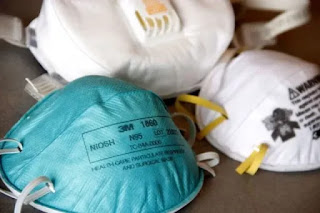
How to get N95 Masks in India - कैसे पाएं मास्क? Yellow, White, Blue or Black ?

कैसे पाएं मास्क? पीला, सफेद, नीला या काला? There are many colors of masks available in India of different colors. What is the difference ? W...